Analysis of Interval- and Ratio-scale Data

Analysis of Interval- and Ratio-scale Data


### Unit IV: Analysis of Interval- and Ratio-scale Data


#### A. **Rationale**

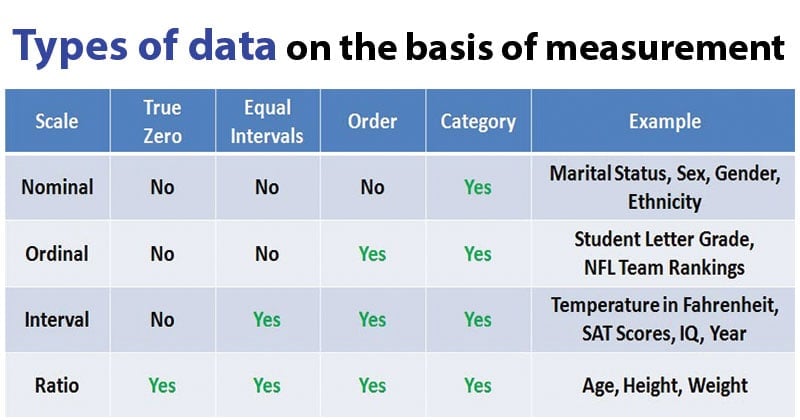
Interval- and ratio-scale data allow for more sophisticated statistical analyses because both scales measure continuous variables. Interval data has meaningful intervals between values, but no true zero point (e.g., temperature in Celsius), while ratio data has a true zero (e.g., income, age). The rationale for analyzing such data is to gain deeper insights into relationships, patterns, and trends, making it possible to perform tests of significance and assess the strength and nature of relationships between variables. This allows researchers to make more precise and reliable inferences about populations.


---


#### B. **Univariate Data Analysis: One-Sample Z, t, and F Tests**


- **Z Test**: A statistical test used to determine whether the mean of a population is significantly different from a hypothesized value when the population variance is known and the sample size is large (n > 30).

  - Formula: 

    \[

    Z = \frac{\bar{X} - \mu}{\sigma / \sqrt{n}}

    \]

    Where:

    - \(\bar{X}\) = Sample mean

    - \(\mu\) = Population mean

    - \(\sigma\) = Population standard deviation

    - \(n\) = Sample size


- **t-Test**: Used when the population variance is unknown and the sample size is small (n < 30). It tests whether the sample mean is significantly different from a hypothesized population mean.

  - Formula:

    \[

    t = \frac{\bar{X} - \mu}{s / \sqrt{n}}

    \]

    Where:

    - \(s\) = Sample standard deviation (used instead of population standard deviation).


- **F Test**: Used to compare the variances of two populations or assess whether multiple group means differ significantly (ANOVA). This test is critical for understanding whether variability between groups is due to chance or a real difference.


---


#### C. **Bivariate Data Analysis**


- **Two-Way Frequency Table**: Similar to nominal data analysis, but in interval/ratio data, the emphasis is more on measuring the strength of the relationship between variables.


- **Scatter Diagram**: A graphical representation that plots two variables on a Cartesian plane. It helps in visualizing the relationship between two interval or ratio variables. The pattern in the scatter diagram provides clues about the direction and strength of the relationship.


- **Correlation Coefficient**: Measures the strength and direction of the relationship between two variables. The most common is **Pearson’s r**, which ranges from -1 to 1. A value close to 1 or -1 indicates a strong relationship, while a value near 0 indicates a weak or no relationship.

  - Formula for Pearson's r:

    \[

    r = \frac{n(\sum xy) - (\sum x)(\sum y)}{\sqrt{[n\sum x^2 - (\sum x)^2][n\sum y^2 - (\sum y)^2]}}

    \]


- **Simple Linear Regression**: A method for predicting the value of a dependent variable based on the value of an independent variable. It establishes a linear relationship between two variables.

  - Formula: 

    \[

    Y = a + bX

    \]

    Where:

    - \(Y\) = Dependent variable

    - \(X\) = Independent variable

    - \(a\) = Intercept

    - \(b\) = Slope (rate of change).


- **Two-Sample Z, t, and F Tests**: These are extensions of the one-sample tests, used when comparing two independent groups:

  - **Two-sample Z Test**: Compares the means of two independent samples when the population variances are known.

  - **Two-sample t-Test**: Used when population variances are unknown, and it tests whether two sample means differ significantly.

  - **Two-sample F Test**: Compares the variances of two independent samples.


- **Significance Tests of Correlation and Regression Coefficients**: These tests determine whether the observed correlation or regression coefficients are statistically significant. The hypothesis test checks if the correlation or slope coefficient is significantly different from zero, indicating a meaningful relationship between the variables.


---


#### D. **Interpretation**

The interpretation of these analyses involves understanding the meaning of the statistical output and its implications. For example:

- In correlation analysis, you interpret the direction (positive or negative) and strength of the relationship.

- In regression analysis, the slope coefficient (\(b\)) indicates the rate of change in the dependent variable for each unit change in the independent variable.

- In significance tests, p-values are used to determine whether the results are statistically significant. A p-value less than 0.05 typically indicates that the relationship or difference is not due to random chance.


---


#### E. **Inference**

Inferences from interval and ratio data analysis help researchers generalize their findings from a sample to the larger population. These tests allow you to make informed conclusions, such as predicting outcomes (e.g., predicting income based on education level), or understanding the strength and nature of relationships between variables in the population. Confidence intervals and hypothesis testing are essential for making these inferences reliable.


---


### **Readings** for this Unit:

1. **Blalock, H.M.** (1969). *Interval Scales: Frequency distribution and graphic presentation* (Chapter 4, pp. 41-54): This chapter covers the basics of summarizing interval-scale data using frequency distributions and visual methods like graphs.

2. **Blalock, H.M.** (1969). *Interval Scales: Measures of Central Tendency* (Chapter 5, pp. 55-76): This reading focuses on the measures of central tendency (mean, median, mode) for interval data.

3. **Blalock, H.M.** (1969). *Two Samples Test: Difference of Means and Proportions* (Chapter 13, pp. 219-242): This chapter explains how to test for significant differences between two samples.

4. **Levin and Fox**, *Elementary Statistics in Social Research*, Chapter 7: "Testing Differences between Means" (pp. 235-268): This reading explains various methods for testing mean differences between groups using z, t, and F tests.

5. **Blalock, H.M.** (1969). *Correlation and Regression* (Chapter 17, pp. 361-396): This chapter provides an in-depth understanding of correlation and regression analysis, crucial for analyzing interval and ratio data.

6. **Levin and Fox**, *Elementary Statistics in Social Research*, Chapters 10 and 11 (pp. 345-392): These chapters further elaborate on correlation and regression analysis, including testing for significance of relationships and interpreting regression coefficients.


These readings will guide you through the theoretical and practical aspects of analyzing interval and ratio-scale data in sociological research. Let me know if you'd like to explore any topic in more detail!

Analysis of Nominal-Scale Data

Analysis of Nominal-Scale Data


### Unit II: Analysis of Nominal-Scale Data


#### A. **Rationale**

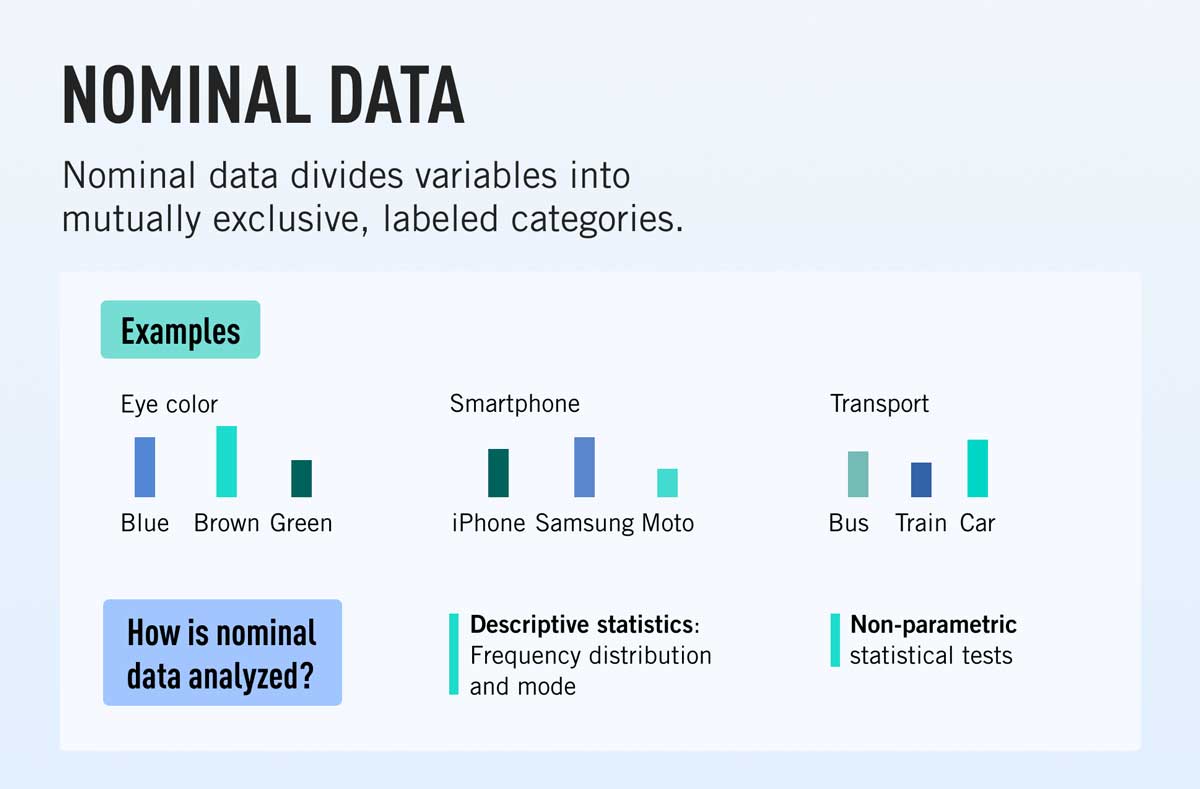
Nominal-scale data refers to data that is categorized without any quantitative value or inherent ranking between the categories. These variables represent distinct groups or types, such as gender, ethnicity, religion, or political affiliation. The key rationale for analyzing nominal data is to summarize and compare proportions or frequencies within different categories, as well as to assess relationships between these categories. Since nominal data does not involve a hierarchy or order, only frequency-based analyses are suitable for such data.


Nominal data is often visualized using bar charts or pie charts to show proportions, and it is analyzed using techniques such as frequency tables and contingency tables to explore relationships between variables.


---


#### B. **Univariate Data Analysis: One-Way Frequency Table**

A **one-way frequency table** is used in univariate analysis (the analysis of a single variable) to display the number of occurrences for each category within a nominal variable. This helps in summarizing how often each category appears in a dataset.


For example, if you are analyzing a dataset on political affiliation with categories such as Democrat, Republican, and Independent, a one-way frequency table would display the count of respondents in each category:

| Political Affiliation | Frequency |

|-----------------------|-----------|

| Democrat              | 100       |

| Republican            | 120       |

| Independent           | 80        |


This table provides a clear, simple representation of how the data is distributed across categories.


---


#### C. **Bivariate Data Analysis: Two-Way Frequency Table and Chi-Square Test**


**Two-Way Frequency Table (Contingency Table)**:

A two-way frequency table, also known as a **contingency table**, is used to explore the relationship between two nominal variables. It shows how frequently each combination of categories occurs. For example, a contingency table might compare **political affiliation** with **gender**:


|                | Democrat | Republican | Independent | Total |

|----------------|----------|------------|-------------|-------|

| Male           | 50       | 70         | 30          | 150   |

| Female         | 50       | 50         | 50          | 150   |

| Total          | 100      | 120        | 80          | 300   |


This table can help sociologists assess whether there is an association between gender and political affiliation.


**Chi-Square Test**:

The chi-square test is a statistical test used to determine whether there is a significant association between two nominal variables. It compares the observed frequencies in the contingency table to the expected frequencies (what would occur if there were no association between the variables).


The formula for the chi-square statistic (χ²) is:

\[

\chi^2 = \sum \frac{(O - E)^2}{E}

\]

Where:

- **O** = Observed frequency

- **E** = Expected frequency (calculated under the assumption of no relationship between the variables)


If the calculated chi-square value exceeds a certain threshold (based on the degrees of freedom and significance level), the null hypothesis (no relationship between the variables) is rejected, indicating that a significant association exists.


---


#### D. **Level of Significance (Measures of Strength of Relationship)**

In hypothesis testing, the **level of significance** (denoted by **α**) is the threshold for determining whether to reject the null hypothesis. Typically, α is set at 0.05, meaning that there is a 5% risk of rejecting the null hypothesis when it is actually true (a Type I error).


- **P-value**: The p-value indicates the probability of observing the test results under the assumption that the null hypothesis is true. If the p-value is less than the level of significance (e.g., p < 0.05), the null hypothesis is rejected.

- **Cramér's V**: This is a measure of the strength of association between two nominal variables. Cramér's V ranges from 0 (no association) to 1 (perfect association). It is derived from the chi-square statistic and accounts for the size of the table.


---


#### E. **Interpretation**

The interpretation of results from chi-square tests or frequency tables involves determining whether there is a statistically significant relationship between variables. If the chi-square test shows significance (p < 0.05), it indicates that the observed relationship between the variables is unlikely to have occurred by chance.


- In the context of a two-way table, the interpretation involves looking at whether the distribution across categories deviates from what would be expected under the assumption of no association.

- In addition, the strength of the relationship (using Cramér's V) can help in determining whether the relationship, even if significant, is weak or strong.


For example, in the political affiliation and gender analysis, if the chi-square test is significant, it may suggest that gender is related to political affiliation in the sample.


---


#### F. **Inference**

Inference in nominal-scale data analysis refers to making generalizations about a population based on the analysis of a sample. After conducting tests like chi-square, sociologists can infer whether the relationships observed in the sample likely hold true for the larger population. This is done while acknowledging the limitations of the data, including sample size, potential biases, and random error.


For example, if the chi-square test reveals a significant relationship between gender and political affiliation in the sample, a researcher might infer that gender plays a role in political affiliation in the broader population, assuming the sample is representative.


---


### **Readings** for this Unit:

1. **Blalock, H.M.** (1969). *Nominal Scales: Proportions, Percentages, and Ratios* (Chapter 3, pp. 31-40): This reading focuses on the application of proportions, percentages, and ratios in the analysis of nominal data, providing a detailed understanding of how these tools can summarize nominal-scale data effectively.

2. **Blalock, H.M.** (1969). *Nominal Scales: Contingency Problems* (Chapter 15, pp. 275-316): This chapter delves into the challenges of analyzing relationships between nominal variables using contingency tables and offers solutions for accurately interpreting contingency problems in sociological research.


These readings will deepen your understanding of nominal-scale data analysis and its application in sociological research. Let me know if you'd like further elaboration on any of these topics!


Key Statistical Concepts

 Key Statistical Concepts


### Unit I: Key Statistical Concepts


#### A. **Grouping and Organizing Data**

Grouping and organizing data is the foundation of statistical analysis. It involves structuring raw data into a manageable format, making it easier to interpret and analyze.


- **Grouping**: This refers to the process of categorizing or classifying data into different groups or classes based on certain characteristics. For example, income levels can be grouped into categories such as low, middle, and high income.

- **Organizing Data**: Once grouped, data is arranged in a structured way to facilitate analysis. This can involve creating frequency tables, charts, or graphs.


#### B. **Univariate, Bivariate, and Multivariate Data and Frequency Distribution**


- **Univariate Data**: This refers to the analysis of a single variable. For example, analyzing the average income of individuals in a dataset is a univariate analysis.

- **Bivariate Data**: Involves the analysis of two variables to determine relationships or correlations. For example, studying the relationship between income and education level.

- **Multivariate Data**: Involves three or more variables, often to explore more complex relationships. For example, analyzing how income, education, and gender together impact employment status.


**Frequency Distribution**: A table that displays the frequency or count of observations for each value or category of a variable. This is often used in univariate analysis to summarize data, and can be visualized through histograms or bar charts.


#### C. **Cross-Sectional, Cohort, and Panel Data**


- **Cross-Sectional Data**: Data collected at a single point in time across various subjects. It provides a snapshot of a population at a specific moment. For example, a survey measuring people's opinions on social issues in 2023.

- **Cohort Data**: A type of longitudinal data where a specific group (cohort) is followed over a period. This is useful for examining how a particular characteristic or event influences a group of people over time. For instance, tracking the educational progress of a group of students who started school in the same year.

- **Panel Data**: Also longitudinal, but it involves repeated observations of the same subjects at multiple time points. It allows researchers to observe changes over time for the same individuals, making it useful for identifying trends.


#### D. **Summarizing Data: Measures of Central Tendency and Dispersion**


- **Measures of Central Tendency**:

  - **Mean**: The average of all data points. It provides a general idea of the "central" value in a dataset.

  - **Median**: The middle value when data is ordered from lowest to highest. It is particularly useful in skewed distributions.

  - **Mode**: The most frequent value in a dataset. It is often used with categorical data.


- **Measures of Dispersion**:

  - **Range**: The difference between the highest and lowest values. It provides a basic sense of variability.

  - **Variance**: The average squared deviation from the mean, showing how much values differ from the mean.

  - **Standard Deviation**: The square root of variance, providing a measure of spread in the same units as the data. It indicates how much the data varies from the mean.


---


### **Readings** for this Unit:

- **Mueller, John H. and Karl F. Schuessler (1969)**, *Statistical Reasoning in Sociology*, New Delhi: Oxford and IBH. (Chapters 3, pp. 29-78): This reading focuses on the foundations of statistical reasoning and methods of summarizing sociological data.

- **Levin and Fox**, *Elementary Statistics in Social Research*: Chapter 2 (Grouping and organizing data), Chapter 3 (Univariate, bivariate, and multivariate data), and Chapter 4 (Summarizing data with central tendency and dispersion measures).

- **T.L. Baker**, *Doing Social Research*: Levels of measurement (pp. 119-125) and cross-sectional or longitudinal study designs (pp. 91-95).


These readings will provide you with theoretical and practical knowledge about key statistical concepts in sociological research. Let me know if you want more detailed explanations or summaries of any specific readings!


Basic Statistical Techniques in Sociological Research

 Basic Statistical Techniques in Sociological Research


### Objectives of the Course: Basic Statistical Techniques in Sociological Research


This course is designed to equip students with the essential skills for analyzing sociological data through basic statistical techniques. The course emphasizes understanding and applying various types of data measurement scales—nominal, ordinal, interval, and ratio—while developing proficiency in organizing and analyzing data. Below, we explore the specific objectives outlined in the course description.


---


### a) **Enable Students to Categorize and Organize Data**


#### Objective Breakdown:

One of the foundational aspects of sociological research is the ability to efficiently categorize and organize data. This objective aims to help students:

- Understand the nature of data collected in sociological research, which can come from surveys, interviews, experiments, or observational studies.

- Learn methods for sorting and classifying data to make analysis more streamlined and meaningful.

- Understand the role of variables and how to distinguish between different types of variables (e.g., independent, dependent, control).


#### Skills Developed:

- **Categorizing Data:** Learn how to distinguish and group variables into distinct categories based on their characteristics.

  - For example, in a survey of household income, data can be categorized by income brackets.

- **Data Organization:** Learn methods like coding, tabulation, and structuring datasets for effective analysis.

  - **Coding** allows for organizing qualitative responses into a format suitable for statistical analysis.

  - **Tabulation** enables students to summarize data in tables, making it easier to draw comparisons.


By achieving this objective, students will gain the ability to structure raw data in ways that are conducive to deeper statistical analysis, facilitating the application of different techniques based on the nature of the data.


---


### b) **Enable Students to Identify Nominal, Ordinal, Interval, and Ratio Scale Data**


#### Objective Breakdown:

Understanding the different types of data measurement scales is critical to choosing appropriate statistical methods. This objective ensures that students can:

- Recognize and differentiate between the four major scales of measurement: nominal, ordinal, interval, and ratio.

- Learn which statistical techniques are best suited for each scale of data.


#### Breakdown of Data Scales:

1. **Nominal Data**:

   - **Definition**: Data classified into distinct categories with no inherent order or ranking.

   - **Examples**: Gender (male, female), political affiliation (Democrat, Republican), ethnicity.

   - **Statistical Methods**: Frequencies, mode, chi-square test, contingency tables.


2. **Ordinal Data**:

   - **Definition**: Data that is placed into categories with a meaningful order, but the differences between the categories are not measurable.

   - **Examples**: Socioeconomic status (low, middle, high), education level (primary, secondary, higher), Likert scale responses (agree, neutral, disagree).

   - **Statistical Methods**: Median, percentile ranks, Spearman’s rank correlation.


3. **Interval Data**:

   - **Definition**: Data with meaningful intervals between values, but no true zero point (zero does not indicate absence).

   - **Examples**: Temperature in Celsius, IQ scores, calendar years.

   - **Statistical Methods**: Mean, standard deviation, t-tests, correlation, ANOVA.


4. **Ratio Data**:

   - **Definition**: Data with all the properties of interval data, but with a true zero point, allowing for comparisons of absolute magnitude.

   - **Examples**: Income, age, height, weight, time.

   - **Statistical Methods**: Geometric mean, ratio analysis, regression, ANOVA.


#### Skills Developed:

- Learn how to categorize data based on its measurement scale.

- Understand which scale is appropriate for specific kinds of sociological questions.

- Practice determining the level of measurement in different datasets.


By mastering this objective, students will be able to distinguish between various data types, ensuring the correct application of statistical techniques to enhance the accuracy of their analysis.


---


### c) **Develop Skills of Analyzing Nominal, Ordinal, Interval, and Ratio Scale Data**


#### Objective Breakdown:

Building on the ability to identify different data scales, this objective emphasizes the development of analytical skills specific to each type of data. Students will learn the following:

- **Statistical techniques** for analyzing nominal, ordinal, interval, and ratio data.

- **Interpretation of results**, allowing students to draw meaningful sociological conclusions from their data.


#### Analysis by Scale Type:

1. **Nominal Data Analysis**:

   - Since nominal data consists of categorical variables without order, students will focus on frequency counts and cross-tabulations to understand distributions.

   - **Key Tools**: Bar charts, pie charts, mode, chi-square tests.


2. **Ordinal Data Analysis**:

   - Ordinal data allows for ranking, so students will learn to apply non-parametric statistical methods (which do not assume normal distribution).

   - **Key Tools**: Median, interquartile range (IQR), rank correlation, Mann-Whitney U test, Wilcoxon signed-rank test.


3. **Interval Data Analysis**:

   - Interval data analysis includes parametric methods, as this data allows for measuring distances between points.

   - **Key Tools**: Mean, standard deviation, correlation, t-tests (for comparing two groups), ANOVA (for comparing three or more groups).


4. **Ratio Data Analysis**:

   - Ratio data, which includes a true zero, allows for the most complex forms of analysis, including ratio comparisons and proportional measures.

   - **Key Tools**: Mean, geometric mean, regression analysis (for predicting dependent variables), ANOVA, and advanced statistical modeling.


#### Skills Developed:

- Ability to apply both **descriptive statistics** (summarizing data) and **inferential statistics** (making predictions and inferences from sample data).

- Understand the assumptions behind different statistical tests, particularly parametric vs. non-parametric methods.

- Develop the capacity to analyze data sets in research scenarios using statistical software like SPSS, R, or Excel.


By achieving this objective, students will gain the necessary skills to perform rigorous data analysis across a variety of contexts, preparing them to tackle complex sociological research questions using data-driven approaches.


---


### Conclusion


By the end of this course, students will be well-equipped with the skills needed to categorize, organize, and analyze sociological data using appropriate statistical techniques. They will have a clear understanding of the distinctions between nominal, ordinal, interval, and ratio data, and they will be able to choose and apply the right methods for analyzing each type of data. These skills are crucial for conducting sociological research and interpreting real-world data effectively, laying the groundwork for higher-level analysis in future studies or professional work.

Basic Statistics in Sociological Research

 Basic Statistics in Sociological Research


### Basic Statistics in Sociological Research


In sociological research, statistics play a fundamental role in analyzing data, uncovering patterns, and making generalizations about social behaviors, structures, and processes. Basic statistical methods allow sociologists to summarize large sets of data, determine relationships between variables, and make informed decisions based on empirical evidence. Below is an overview of key statistical concepts and techniques commonly used in sociological research:


### 1. **Descriptive Statistics**


Descriptive statistics summarize or describe the main features of a dataset. They provide an overview of the data through measures of central tendency, dispersion, and frequency distribution. The primary tools of descriptive statistics include:


#### a. **Measures of Central Tendency**

These measures indicate the central or typical value in a dataset:

   - **Mean (Arithmetic Average):** The sum of all values divided by the number of observations. The mean is useful for understanding the overall trend in data, but it is sensitive to extreme values (outliers).

   - **Median:** The middle value when data are arranged in ascending or descending order. The median is particularly useful when dealing with skewed data or outliers, as it gives a better sense of the "middle" without being affected by extreme values.

   - **Mode:** The most frequent value in a dataset. The mode is used in categorical data or when you need to identify the most common response or outcome in a dataset.


#### b. **Measures of Dispersion (Variability)**

These measures assess how spread out the data are:

   - **Range:** The difference between the highest and lowest values in the dataset. While easy to compute, the range can be influenced heavily by outliers.

   - **Variance:** The average of the squared differences from the mean. It gives a sense of how much individual data points deviate from the mean.

   - **Standard Deviation:** The square root of the variance, providing a measure of dispersion in the same units as the data. A low standard deviation means that data points tend to be close to the mean, while a high standard deviation indicates greater variability.

   - **Interquartile Range (IQR):** The range of the middle 50% of the data, calculated as the difference between the 75th percentile (Q3) and the 25th percentile (Q1). It is resistant to outliers and useful for comparing the spread of different datasets.


#### c. **Frequency Distribution**

Frequency distribution describes how often different values or categories occur in a dataset. Sociologists often use tables, histograms, or bar charts to represent frequency distributions, allowing them to visualize patterns and trends in data, especially in categorical or ordinal data.


### 2. **Inferential Statistics**


While descriptive statistics help summarize data, **inferential statistics** allow sociologists to make generalizations or inferences about a population based on a sample. Inferential statistics involve hypothesis testing, estimation, and determining the likelihood that a result found in a sample applies to the larger population.


#### a. **Sampling**

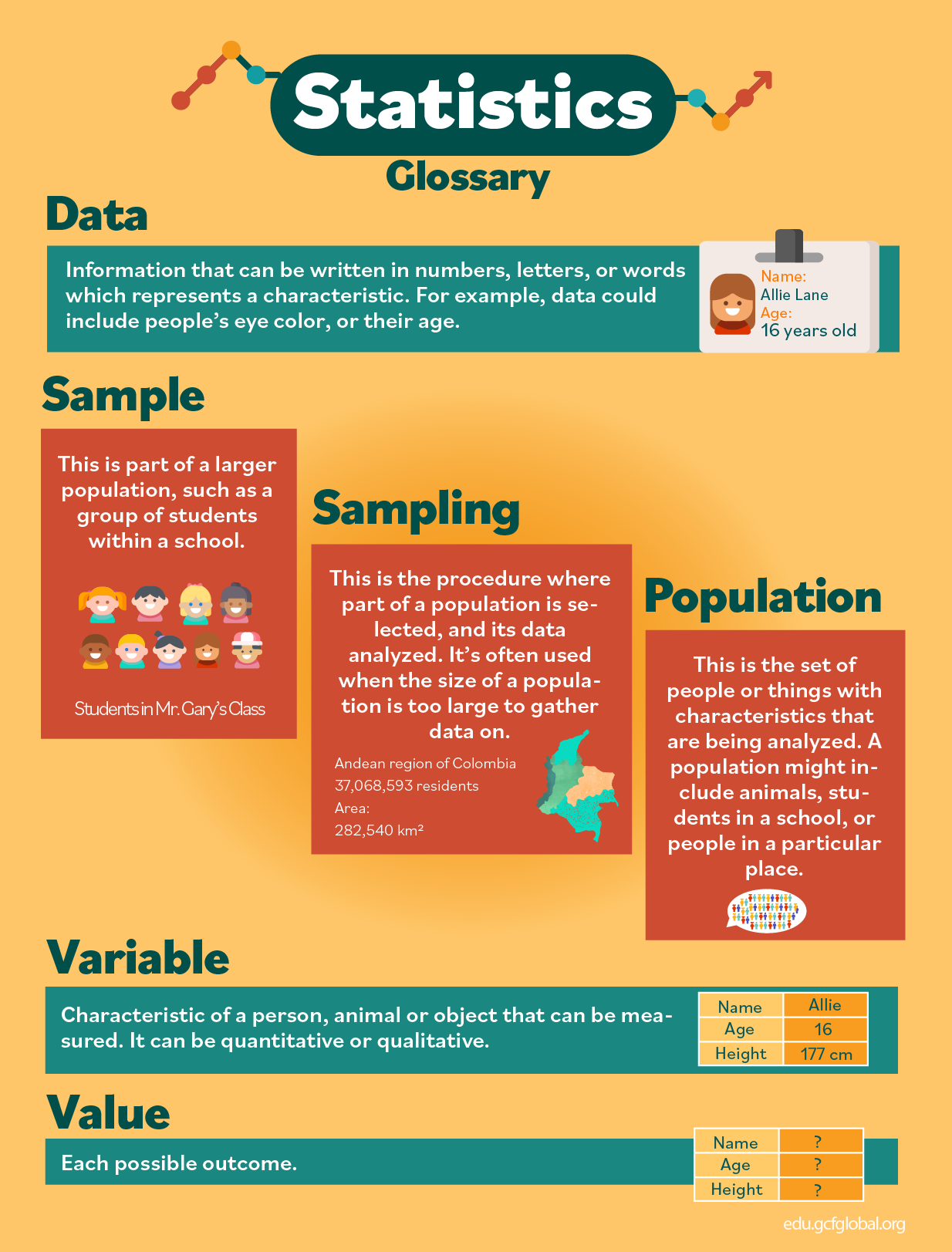
Sociological research often deals with large populations, making it impossible to collect data from every individual. A **sample** is a subset of the population, and **sampling methods** (e.g., random sampling, stratified sampling, convenience sampling) are used to select participants. In inferential statistics, the goal is to make conclusions about the broader population from the sample data.


#### b. **Hypothesis Testing**

Hypothesis testing involves making claims about a population parameter (such as the mean) and using sample data to test these claims. The basic steps are:

   - **Null Hypothesis (H₀):** A statement that there is no effect or no relationship between variables. For example, "There is no relationship between education level and income."

   - **Alternative Hypothesis (H₁):** A statement that contradicts the null hypothesis, suggesting an effect or relationship exists. For example, "Higher education levels lead to higher income."

   - **Significance Level (α):** A threshold (often 0.05) that determines when to reject the null hypothesis. If the p-value (probability of obtaining the observed results under the null hypothesis) is lower than α, the null hypothesis is rejected.

   - **Type I and Type II Errors:** A **Type I error** occurs when the null hypothesis is wrongly rejected (false positive), while a **Type II error** occurs when the null hypothesis is not rejected despite being false (false negative).


#### c. **T-tests and ANOVA**

   - **T-test:** Used to compare the means of two groups to determine if they are statistically different. For instance, it can be used to test whether the mean income of men differs significantly from that of women.

   - **Analysis of Variance (ANOVA):** An extension of the t-test, ANOVA is used when comparing the means of three or more groups. For example, sociologists can use ANOVA to examine whether educational achievement varies across different socioeconomic groups.


#### d. **Correlation and Regression**

   - **Correlation:** A statistical measure (denoted as 'r') that describes the strength and direction of a relationship between two variables. Correlations can range from -1 to +1, where +1 indicates a perfect positive relationship, -1 indicates a perfect negative relationship, and 0 indicates no relationship.

   - **Regression Analysis:** A more advanced statistical tool used to understand the relationship between an independent variable (predictor) and a dependent variable (outcome). Simple linear regression models the relationship between two variables, while multiple regression considers the influence of several independent variables on a dependent variable.


### 3. **Bivariate and Multivariate Analysis**


Sociologists are often interested in relationships between two or more variables:


#### a. **Bivariate Analysis**

This involves examining the relationship between two variables. The most common methods include:

   - **Cross-tabulation (Contingency Table):** A table that shows the frequency distribution of two categorical variables. Sociologists use cross-tabulation to explore how one variable is distributed across levels of another, such as how political party affiliation varies by age group.

   - **Chi-Square Test:** A statistical test used to determine whether there is a significant association between two categorical variables.


#### b. **Multivariate Analysis**

Multivariate analysis involves examining relationships between three or more variables simultaneously. Techniques such as **multiple regression** or **factor analysis** help sociologists understand the complex interrelationships among variables and control for confounding factors.


### 4. **Using Statistics in Sociological Research**

Statistics are essential in sociological research for the following reasons:

   - **Objectivity and Precision:** Statistical methods provide an objective basis for testing hypotheses and identifying patterns, reducing the risk of researcher bias.

   - **Data Summarization:** Large datasets can be summarized and represented effectively through statistical tools, making complex social phenomena easier to understand.

   - **Predictive Analysis:** Statistical techniques such as regression help sociologists make predictions about social outcomes, like how certain factors (e.g., education, income, age) influence behaviors or trends.

   - **Policy and Decision Making:** Findings from sociological research often inform policymakers, and statistical analysis adds weight to the evidence provided.


### Conclusion

Basic statistics are an indispensable part of sociological research. From descriptive statistics that summarize data to inferential methods that allow researchers to draw conclusions about broader populations, statistical tools enable sociologists to analyze social phenomena scientifically. Understanding these basic concepts is crucial for designing studies, analyzing data, and interpreting research findings in a meaningful way.

Popular Posts