Basic Statistics in Sociological Research Important Questions

 Basic Statistics in Sociological Research Important Questions


Here are 10 important questions that cover the key concepts from all the units you've studied so far. These questions will help you prepare for your exams, focusing on both theoretical understanding and practical application:


### **Unit I: Key Statistical Concepts**


1. **Explain the differences between univariate, bivariate, and multivariate data. Provide examples of how each type can be used in sociological research.**

   - This question tests your understanding of different data types and their applications.


2. **Discuss the importance of summarizing data through measures of central tendency and measures of dispersion. How do mean, median, mode, range, variance, and standard deviation help in sociological analysis?**

   - This will require you to explain the significance of these statistical measures and how they are applied.


3. **Compare and contrast cross-sectional, cohort, and panel data. In what situations would each type be used in sociological research?**

   - This question focuses on different research designs and when to use each.


---


### **Unit II: Analysis of Nominal-scale Data**


4. **What is the rationale for analyzing nominal-scale data? How are proportions, percentages, and ratios used in nominal-scale analysis?**

   - You need to explain the reasoning behind nominal-scale data analysis and its practical application.


5. **Explain how the chi-square test is used in bivariate analysis of nominal-scale data. What is the role of the level of significance in this analysis?**

   - This will test your understanding of the chi-square test and significance levels in sociological research.


---


### **Unit III: Analysis of Ordinal-scale Data**


6. **Discuss the rationale for analyzing ordinal-scale data. How do you interpret the results of a rank correlation coefficient?**

   - This question focuses on the rationale for ordinal data analysis and the interpretation of rank correlation.


---


### **Unit IV: Analysis of Interval- and Ratio-scale Data**


7. **What is the difference between a one-sample Z test, t-test, and F test? In what research situations would you use each?**

   - This question tests your knowledge of the different tests for interval and ratio data and their applications.


8. **Explain the concept of a scatter diagram and correlation coefficient. How would you interpret a Pearson's correlation coefficient in a sociological study?**

   - This requires you to explain and apply the concept of correlation to real-world sociological research.


---


### **Unit V: Analysis of Variance (ANOVA)**


9. **What is the logic behind Analysis of Variance (ANOVA)? How does ANOVA differ from a t-test, and when would you use ANOVA in sociological research?**

   - This question will assess your understanding of the fundamental logic of ANOVA and its comparison to other statistical tests.


10. **After conducting ANOVA, why is it necessary to perform multiple comparison tests? Describe Tukey's HSD and how it is used to interpret the results of ANOVA.**

   - This will test your understanding of post-hoc tests and their importance after ANOVA.


---


These questions cover a wide range of statistical concepts, including data types, analysis techniques, and interpretation, all essential for your sociology exams. Let me know if you need any additional explanations or practice questions!

Analysis of Variance (ANOVA)

Analysis of Variance (ANOVA)


### Unit V: Analysis of Variance (ANOVA)


#### A. **The Logic of Analysis of Variance**

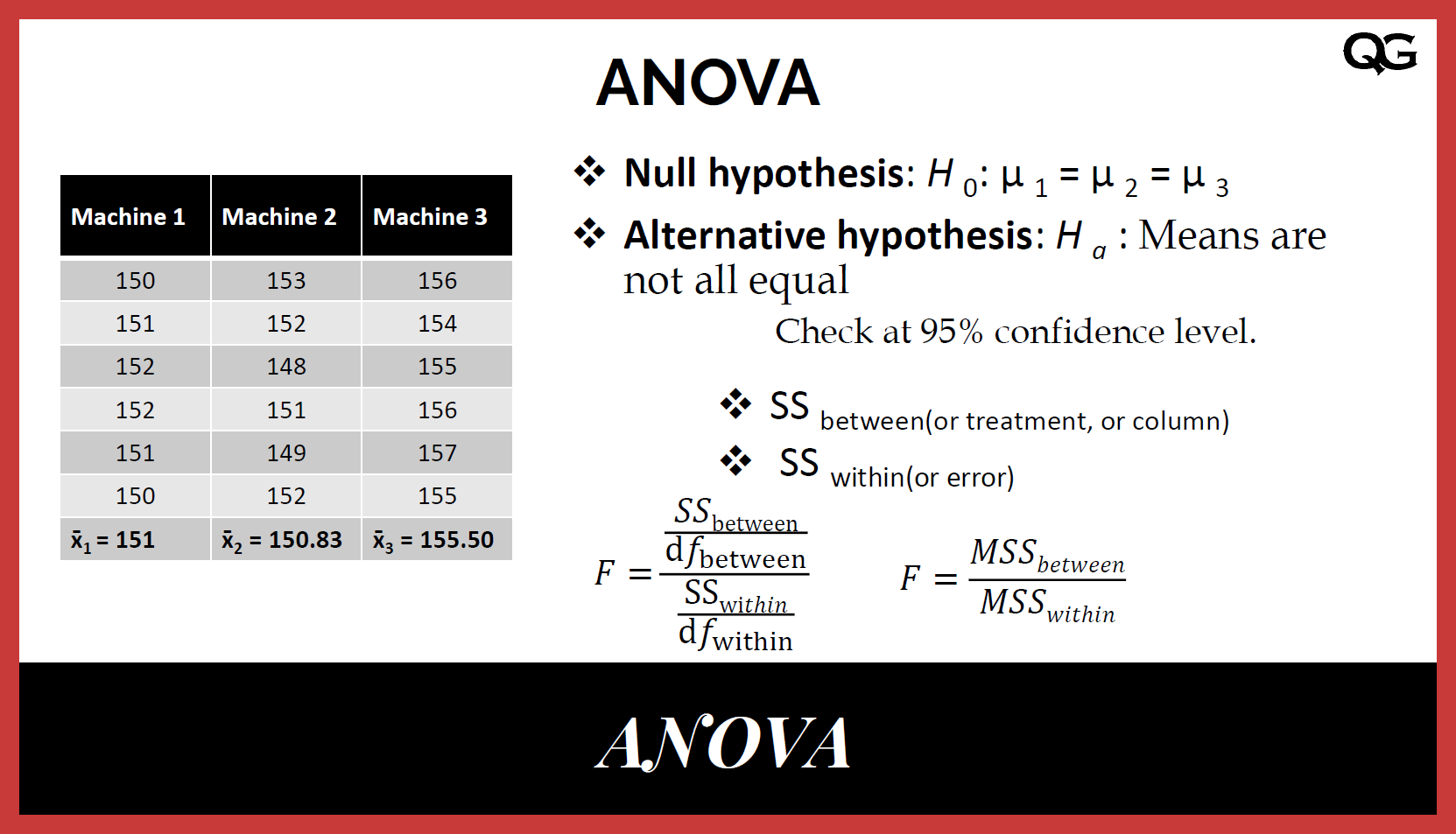
Analysis of Variance (ANOVA) is a statistical technique used to determine whether there are significant differences between the means of three or more groups. The key logic behind ANOVA is to test the hypothesis that all group means are equal, versus the alternative hypothesis that at least one group mean is different. 


ANOVA compares the variance within each group to the variance between the groups:

- **Within-group variance** measures how much individuals in the same group differ from the group mean.

- **Between-group variance** measures how much the group means differ from the overall mean.


If the between-group variance is significantly larger than the within-group variance, it suggests that the groups are not all the same, leading to the rejection of the null hypothesis.


The F-ratio is used in ANOVA to compare these variances:

\[

F = \frac{\text{Between-group variance}}{\text{Within-group variance}}

\]

If the F-ratio is large, it suggests that there is a significant difference between group means.


---


#### B. **Analysis of Variance**

ANOVA can be conducted for different types of data:

- **One-Way ANOVA**: Used when comparing the means of three or more independent groups on one factor. For example, you might compare the academic performance (measured by test scores) of students from three different educational methods.


  Steps in One-Way ANOVA:

  1. Calculate the **total variance** (the variance of all observations).

  2. Break down the total variance into **between-group variance** and **within-group variance**.

  3. Compute the **F-ratio**.

  4. Compare the F-ratio to a critical value from the F-distribution table, which depends on the number of groups and sample sizes. If the calculated F-ratio is larger than the critical value, the null hypothesis (that all group means are equal) is rejected.


- **Two-Way ANOVA**: Used when there are two independent variables, allowing the researcher to assess not only the main effects of each variable but also the interaction effect between the two variables. For instance, you might examine the effects of both gender and study method on academic performance.


---


#### C. **Multiple Comparison of Means**

After conducting ANOVA, if the null hypothesis is rejected, it indicates that at least one group mean is different, but it doesn’t specify which groups are significantly different. To determine which specific group means differ from each other, **multiple comparison tests** (also called post hoc tests) are used. Common methods include:


- **Tukey’s Honestly Significant Difference (HSD)**: Compares all possible pairs of means to identify which ones are significantly different.


- **Bonferroni Correction**: Adjusts the significance level to account for multiple comparisons, reducing the chance of Type I errors (false positives).


- **ScheffĂ©’s Test**: A more conservative post hoc test, especially useful when comparing all possible contrasts between means, not just pairwise comparisons.


These tests help provide a clearer picture of where the significant differences lie between the groups, beyond simply knowing that differences exist.


---


### **Readings** for this Unit:

1. **Levin and Fox**. (1969). *Analysis of Variance* (Chapter 8, pp. 283-308): This chapter provides an overview of the theory and application of ANOVA, focusing on how to conduct the analysis and interpret the results.

2. **Blalock, H.M.** (1969). *Analysis of Variance* (Chapter 16, pp. 317-360): This reading delves deeper into the mathematical foundation of ANOVA, offering a more comprehensive understanding of the statistical principles involved.


These readings will give you a solid foundation in understanding and applying ANOVA in sociological research, particularly when comparing group means. Let me know if you need further elaboration on any specific point!

Popular Posts