World-Systems and Dependency Theories
7. World-Systems and Dependency Theories
Question: Compare and contrast world-systems theory with dependency theory. What are the key critiques and new directions proposed by scholars like James Petras in understanding global inequalities?
Relevant Readings: James Petras, “Dependency and World-System Theory: A Critique and New Directions.”
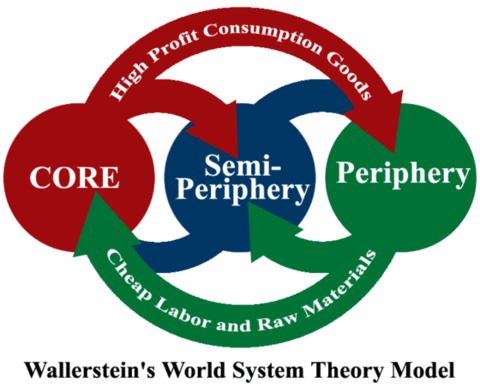
World-systems theory and dependency theory are two influential frameworks in understanding global inequalities and the dynamics of capitalism. While both theories share common roots in Marxist thought and critique the exploitative relationships between developed and developing nations, they differ significantly in their perspectives and analytical approaches. Scholars like James Petras have contributed to these debates by offering critiques and proposing new directions for understanding global inequalities.
## Comparison of World-Systems Theory and Dependency Theory
### 1. **Foundational Concepts**
- **World-Systems Theory**: Developed by Immanuel Wallerstein in the 1970s, this theory posits that the world is divided into core, semi-periphery, and periphery nations, which are interconnected through a capitalist world economy. Wallerstein emphasizes the importance of the global system over individual nation-states, arguing that economic relationships and structures shape social dynamics and inequalities. The core countries exploit peripheral ones for resources and labor, while semi-peripheral countries play a dual role, sometimes exploiting and sometimes being exploited.
- **Dependency Theory**: Emerging in the 1960s and 1970s, dependency theory focuses on the economic and political relationships between developed (core) and developing (peripheral) countries. It posits that the underdevelopment of peripheral countries is a direct result of their exploitation by core countries. Key figures like Andre Gunder Frank and Raúl Prebisch argue that this exploitation leads to a cycle of dependency, where peripheral nations remain economically subordinate and unable to achieve self-sustained growth.
### 2. **Analytical Focus**
- **World-Systems Theory**: Wallerstein's approach emphasizes the global context and the interdependence of countries within the capitalist system. It critiques the simplistic binary of core and periphery by introducing a more nuanced tripartite model. Wallerstein argues that economic exploitation occurs not only between nations but also within them, as core capitalists exploit workers across the entire capitalist world economy.
- **Dependency Theory**: This theory tends to focus more on the historical and structural factors that create and perpetuate dependency. It often highlights the role of colonialism and imperialism in shaping economic relationships and emphasizes the need for peripheral countries to break free from these exploitative ties to achieve development.
## Key Critiques by James Petras
In his work, James Petras critiques both dependency and world-systems theories, highlighting their limitations and proposing new directions for understanding global inequalities:
### 1. **Theoretical Limitations**
- **Overgeneralization**: Petras argues that both theories can overgeneralize the experiences of countries within the global system. He suggests that they often fail to account for the diversity of historical, cultural, and political contexts that shape each nation’s development trajectory.
- **Neglect of Local Dynamics**: Petras emphasizes the importance of local factors and internal class struggles that influence development. He critiques the tendency of both theories to focus primarily on external relationships, which can obscure the complexities of domestic politics and social movements.
### 2. **New Directions**
- **Emphasis on Social Movements**: Petras advocates for a greater focus on social movements and grassroots activism as critical drivers of change. He argues that understanding the agency of local populations is essential for analyzing how societies can resist exploitation and pursue alternative development paths.
- **Integration of Multiple Factors**: He calls for a more integrated approach that considers economic, political, cultural, and environmental factors in understanding global inequalities. This perspective recognizes that development is not solely determined by external forces but is also shaped by internal dynamics and the actions of local actors.
## Conclusion
World-systems theory and dependency theory provide valuable frameworks for analyzing global inequalities and the dynamics of capitalism. While they share common roots and critiques of exploitative relationships, they differ in their analytical focus and conceptual frameworks. James Petras's critiques highlight the limitations of both theories and propose new directions that emphasize the importance of local dynamics and social movements in understanding and addressing global inequalities. This ongoing dialogue between these theoretical perspectives enriches the discourse on global capitalism and development, encouraging a more nuanced and comprehensive understanding of the complexities involved.
Citations:
[1] https://www.elgaronline.com/abstract/book/9781800375918/ch91.xml
[2] http://www.eolss.net/sample-chapters/c04/e6-99a-36.pdf
[3] https://en.wikipedia.org/wiki/World-systems_theory
[4] https://www.usna.edu/NAFAC/_files/round_tables/opferman/A%20Preliminary%20Test%20of%20the%20Theory%20of%20Dependency.pdf
[5] https://www.journals.uchicago.edu/doi/abs/10.1086/226431
[6] https://web.mit.edu/esd.83/www/notebook/WorldSystem.pdf
[7] https://journals.sagepub.com/doi/abs/10.1177/223386599900200106
[8] https://revisesociology.com/2015/12/05/world-systems-theory/