Scatter Diagram and Correlation Coefficient

 Scatter Diagram and Correlation Coefficient


## Scatter Diagram and Correlation Coefficient


### Scatter Diagram


A **scatter diagram** (or scatter plot) is a graphical representation that displays the relationship between two quantitative variables. Each point on the scatter plot corresponds to an observation in the dataset, with one variable plotted along the X-axis and the other along the Y-axis. This visual representation helps to identify patterns, trends, and potential correlations between the variables.


#### Key Features:

- **Axes**: The horizontal axis (X-axis) typically represents the independent variable, while the vertical axis (Y-axis) represents the dependent variable.

- **Data Points**: Each point on the diagram represents a pair of values from the two variables being analyzed.

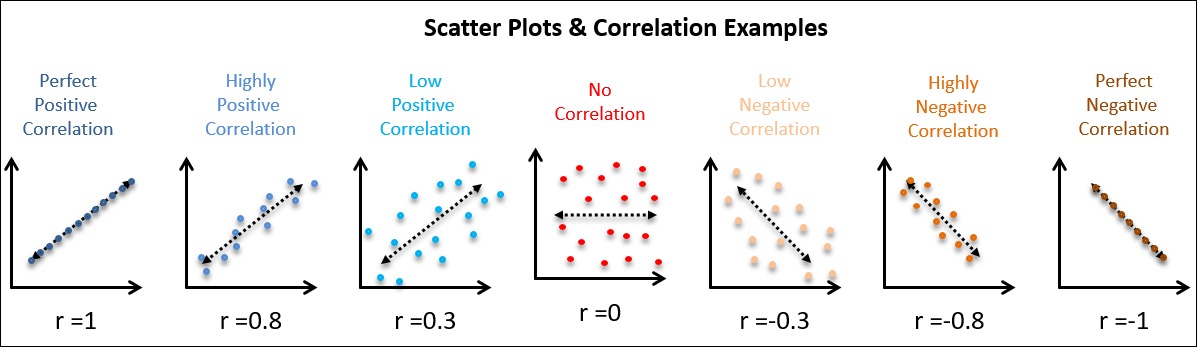
- **Correlation Identification**: The pattern of the plotted points indicates the nature of the relationship:

  - **Positive Correlation**: Points trend upwards from left to right, indicating that as one variable increases, the other also tends to increase.

  - **Negative Correlation**: Points trend downwards from left to right, indicating that as one variable increases, the other tends to decrease.

  - **No Correlation**: Points are scattered without any discernible pattern, suggesting no relationship between the variables.


### Correlation Coefficient


The **correlation coefficient** quantifies the strength and direction of the relationship between two variables. The most commonly used correlation coefficient is **Pearson's correlation coefficient (r)**, which ranges from -1 to +1.


#### Interpretation of Pearson's Correlation Coefficient:

- **+1**: Perfect positive correlation. As one variable increases, the other variable increases perfectly in a linear fashion.

- **0**: No correlation. Changes in one variable do not predict changes in the other variable.

- **-1**: Perfect negative correlation. As one variable increases, the other variable decreases perfectly in a linear fashion.


### Interpretation in a Sociological Study


In a sociological context, interpreting Pearson's correlation coefficient involves understanding the implications of the relationship between two social variables. For example, consider a study examining the relationship between education level (measured in years) and income (measured in dollars).


1. **Positive Correlation (e.g., r = 0.8)**:

   - Interpretation: There is a strong positive correlation between education level and income. This suggests that as education level increases, income tends to increase as well. This finding could support policies aimed at increasing educational access as a means to improve economic outcomes.


2. **No Correlation (e.g., r = 0.0)**:

   - Interpretation: There is no correlation between education level and income. This could indicate that other factors, such as job market conditions or personal circumstances, play a more significant role in determining income than education alone.


3. **Negative Correlation (e.g., r = -0.5)**:

   - Interpretation: A moderate negative correlation might suggest that as one variable increases, the other decreases. For example, if the study found a negative correlation between hours spent on social media and academic performance, it could imply that increased social media use may be associated with lower academic achievement.


### Conclusion


Scatter diagrams and correlation coefficients are essential tools in sociological research for visualizing and quantifying relationships between variables. By interpreting Pearson's correlation coefficient, researchers can draw meaningful conclusions about the nature and strength of associations, informing both theoretical understanding and practical policy implications.


Citations:

[1] https://www.vedantu.com/commerce/scatter-diagram

[2] https://byjus.com/commerce/scatter-diagram/

[3] https://asq.org/quality-resources/scatter-diagram

[4] https://www.geeksforgeeks.org/scatter-diagram-correlation-meaning-interpretation-example/

[5] https://byjus.com/maths/scatter-plot/

[6] https://en.wikipedia.org/wiki/Spearman%27s_rank_correlation_coefficient

[7] https://www.westga.edu/academics/research/vrc/assets/docs/ChiSquareTest_LectureNotes.pdf

[8] https://byjus.com/maths/chi-square-test/


One-Sample Z Test

 One-Sample Z Test


The **one-sample Z test**, **t-test**, and **F test** are statistical methods used to analyze data and test hypotheses in various research situations. Each test has specific applications based on sample size, data distribution, and the nature of the hypothesis being tested. Below is a detailed comparison of these tests, including when to use each.


## One-Sample Z Test


### Definition

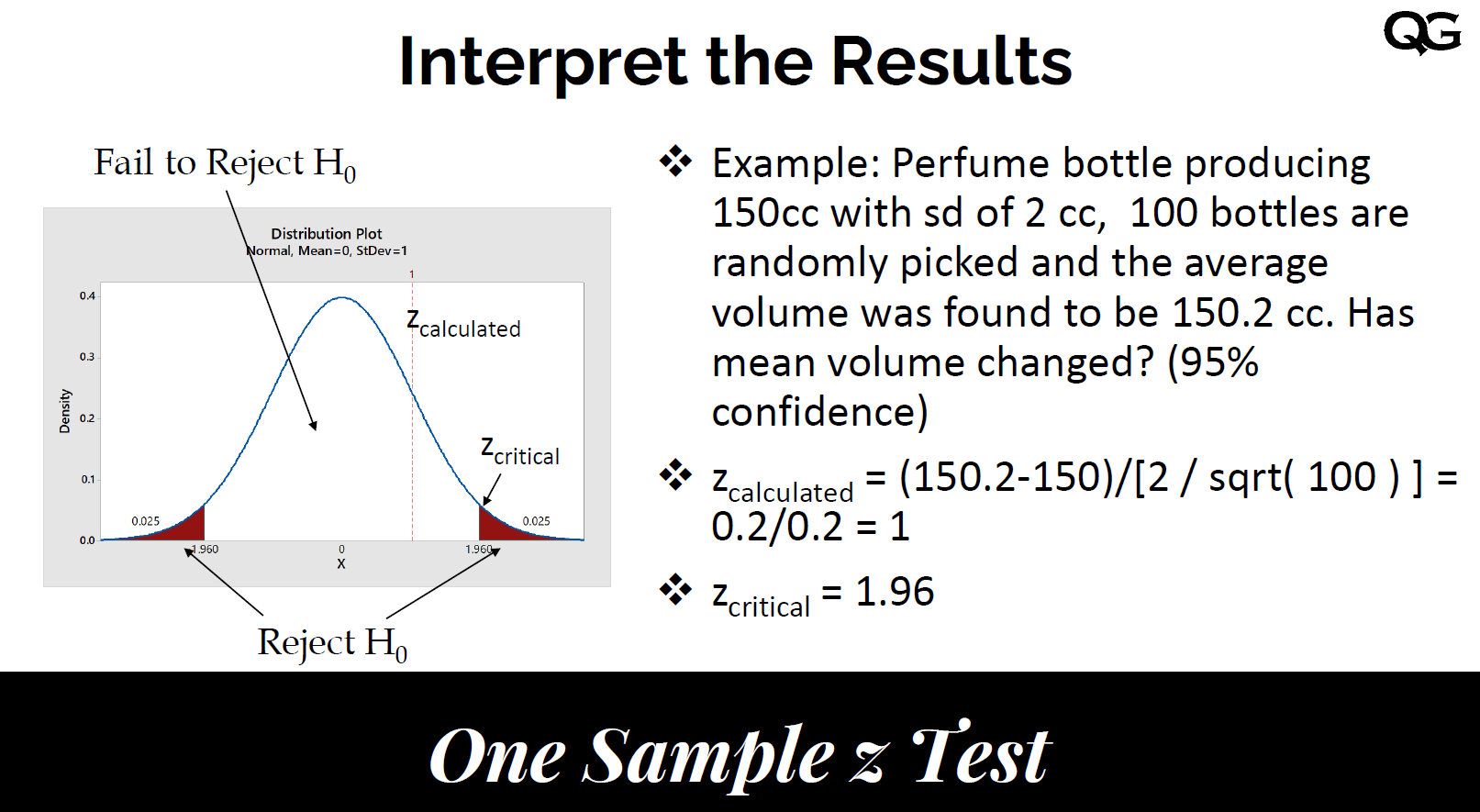
The one-sample Z test is used to determine whether the mean of a single sample differs significantly from a known population mean when the population variance is known. It is applicable primarily when the sample size is large (typically $$n \geq 30$$).


### When to Use

- **Large Sample Size**: When the sample size is 30 or more.

- **Known Population Variance**: When the population standard deviation is known.

- **Normal Distribution**: When the data is approximately normally distributed.


### Example

A researcher wants to test if the average height of a sample of students differs from the known average height of students in the population, which is 170 cm. If the sample size is 50 and the population standard deviation is known, a Z test would be appropriate.


## T-Test


### Definition

The t-test is used to compare the means of one or two groups when the population variance is unknown and the sample size is small (typically $$n < 30$$). There are different types of t-tests, including one-sample, independent samples, and paired samples t-tests.


### When to Use

- **Small Sample Size**: When the sample size is less than 30.

- **Unknown Population Variance**: When the population standard deviation is not known.

- **Normal Distribution**: When the data is normally distributed.


### Example

If a researcher wants to determine whether the average test score of a class of 25 students is significantly different from the national average score of 75, they would use a one-sample t-test.


## F Test


### Definition

The F test is used to compare the variances of two or more groups. It is often employed in the context of ANOVA (Analysis of Variance) to determine if there are any statistically significant differences between the means of multiple groups.


### When to Use

- **Comparing Variances**: When the goal is to assess whether the variances of two or more groups are significantly different.

- **Multiple Groups**: When comparing means across multiple groups (more than two).


### Example

A researcher may use an F test to compare the variances of test scores among three different teaching methods to see if one method has more variability than the others.


## Summary of Differences


| Test Type        | Sample Size Requirement | Known Variance | Purpose                                   | Example Application                                     |

|------------------|-------------------------|----------------|-------------------------------------------|--------------------------------------------------------|

| One-Sample Z Test| $$n \geq 30$$           | Known          | Compare sample mean to a known population mean | Testing if average height of students differs from a known average |

| T-Test           | $$n < 30$$              | Unknown        | Compare sample mean to a known population mean or compare means of two groups | Testing if average test scores of a small class differ from national average |

| F Test           | Any size                | Not applicable | Compare variances of two or more groups   | Comparing variances of test scores among different teaching methods |


## Conclusion


Understanding the differences between the one-sample Z test, t-test, and F test is crucial for selecting the appropriate statistical method based on the research design, sample size, and data characteristics. Each test serves a specific purpose, helping researchers draw valid conclusions from their data.


Citations:

[1] https://brandalyzer.blog/2010/12/05/difference-between-z-test-f-test-and-t-test/

[2] https://www.cuemath.com/data/z-test/

[3] https://testbook.com/key-differences/difference-between-t-test-and-f-test

[4] https://www.shiksha.com/online-courses/articles/difference-between-z-test-and-t-test-blogId-158833

[5] https://www.ncbi.nlm.nih.gov/pmc/articles/PMC6813708/

[6] https://www.investopedia.com/terms/z/z-test.asp

[7] https://www.simplilearn.com/tutorials/statistics-tutorial/z-test-vs-t-test

[8] https://www.scribbr.com/statistics/chi-square-tests/


Popular Posts